


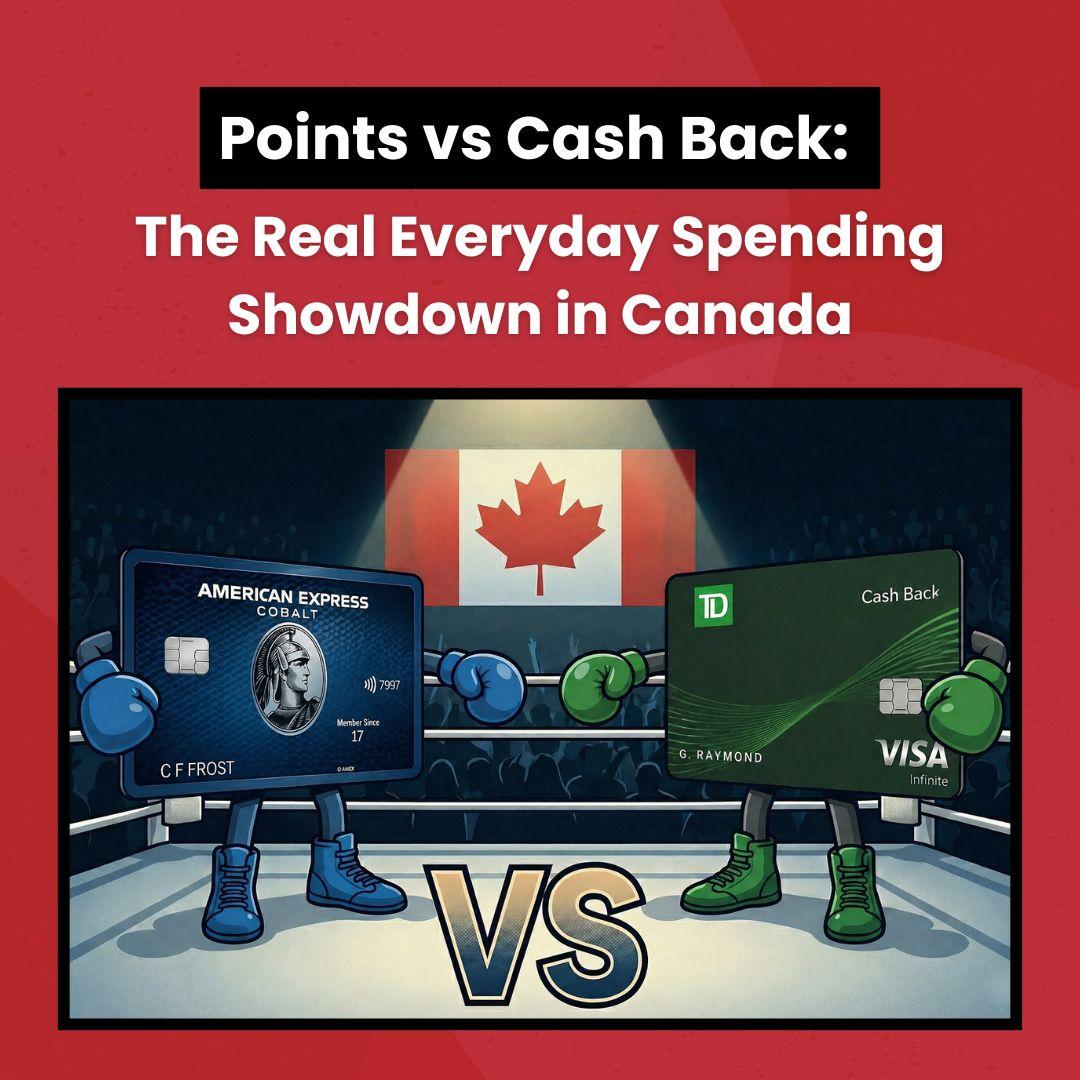
Choosing a credit card for everyday spending sounds simple until you start comparing the details. One card offers flexible points that can feel incredibly powerful if you spend heavily on groceries, restaurants, and food delivery. The other offers straightforward cash back on practical categories like groceries, gas, public transit, recurring bills, and streaming. On paper, both cards look strong. In real life, the better choice depends on how you spend, where you shop, how much effort you want to put into rewards, and whether you prefer points or cash back.
That is why the comparison of Amex Cobalt vs. TD Cash Back Visa Infinite in Canada deserves more than a quick “which card has the higher earn rate?” answer. A card can look better in one category and still feel worse for your lifestyle. A high rewards rate does not help if your favourite stores do not accept the card. A simple cash back structure can feel less exciting than travel points, but it can be far easier to understand, redeem, and use consistently. The best everyday card is not always the one with the flashiest headline rate. It is the one that turns your real monthly spending into dependable value.
For many Canadians, this decision comes down to two different reward personalities. The American Express Cobalt Card suits people who want high earning potential on food-related spending and flexible Membership Rewards points. The TD Cash Back Visa Infinite Card suits people who want practical, predictable cash back across essential categories and the wider acceptance of Visa. American Express currently lists the Cobalt Card fee at $15.99 per month, or $191.88 annually, for non-Quebec residents. In contrast, TD lists the TD Cash Back Visa Infinite Card with an annual fee of $139 and a $60,000 personal or $100,000 household income requirement.
This guide breaks down Amex Cobalt vs. TD Cash Back Visa Infinite in Canada in a practical, human way. We will compare earning categories, annual value, redemption style, acceptance, budgeting fit, and which type of Canadian spender each card best serves. The goal is not to crown a universal winner. The goal is to help you choose the card that earns more for your life.
Quick Overview: Two Strong Cards With Very Different Personalities
The Amex Cobalt Card is often viewed as an everyday points powerhouse because its strongest earn category sits exactly where many Canadians spend heavily: food. American Express says the Cobalt earns 5 points per $1 on eligible eats and drinks, including eligible restaurants, bars, cafés, grocery stores, and food delivery in Canada, up to a monthly cap. It also earns 3 points per $1 on eligible streaming subscriptions in Canada, 2 points per $1 on eligible gas, transit, and ride share purchases in Canada, and 1 point per $1 on other card purchases.
The TD Cash Back Visa Infinite Card offers a more direct cash back approach. TD’s welcome guide says the card earns 3% in Cash Back Dollars on eligible grocery, gas, and electric vehicle charging, public transit, recurring bill payments, and streaming, digital gaming, and media purchases, plus 1% in Cash Back Dollars on all other purchases. TD also states that Cash Back Dollars can be redeemed annually or at any time, subject to conditions, including a minimum amount for certain redemptions.
At a glance, the Cobalt looks more rewarding for food-heavy users, while the TD card looks more practical for people who want broad everyday cash back across household categories. That difference matters because everyday spending is not one category. It includes groceries, gas, coffee, streaming, phone bills, insurance, transit, dining, online subscriptions, occasional travel, and everything else that quietly fills the month. A meaningful comparison of Amex Cobalt vs. TD Cash Back Visa Infinite in Canada has to look at how those categories work together.
Groceries: Where Amex Cobalt Can Pull Ahead
Groceries are one of the biggest recurring expenses for Canadian households, so this category can make or break the comparison. The Amex Cobalt Card earns 5 points per $1 on eligible grocery purchases at stores in Canada, as part of its eats and drinks category, up to the applicable cap. If you redeem Membership Rewards points at a straightforward statement credit value of 1,000 points for $10, that 5x earn rate can behave like a 5% return before considering higher-value travel redemptions. American Express states that 1,000 points equal a $10 statement credit toward eligible purchases when using points this way.
The TD Cash Back Visa Infinite Card earns 3% in Cash Back Dollars on eligible grocery purchases, which is simpler and still very competitive. For someone who wants to see cash back accumulate without having to think about point values, 3% is easy to understand. If you spend $800 per month on eligible groceries, the TD card would generate about $24 per month from that category before considering caps, terms, or promotional offers. The Cobalt could generate 4,000 points on the same spend if the grocery store qualifies, which can equal $40 in statement credit value under the 1,000 points for $10 redemption method.
However, the grocery category comes with an important real-world caveat. Not every place Canadians buy groceries codes the same way, and not every grocery merchant accepts American Express. Warehouse-style or general merchandise retailers may not qualify the way shoppers expect. American Express notes that merchants are typically categorized by what they sell, and purchases at merchants whose eligible categories are not their primary business may not qualify.
This means Cobalt can win strongly when your grocery stores accept Amex and code properly. TD can win over shoppers who want fewer acceptance worries and a clearer cash back structure. In the grocery round of Amex Cobalt vs. TD Cash Back Visa Infinite in Canada, Amex Cobalt has the higher potential. In contrast, TD Cash Back Visa Infinite has a more predictable experience.
Dining, Coffee, and Food Delivery: The Cobalt Advantage Is Hard to Ignore
If your everyday spending includes restaurants, cafés, quick-service meals, and food delivery, the Cobalt becomes difficult to beat. American Express includes eligible restaurants, bars, cafés, and food delivery in Canada in the Cobalt’s 5 points per $1 category. This is one of the reasons many urban Canadians and busy professionals find the card appealing. It rewards the exact habits that define modern everyday spending: lunch near work, coffee runs, takeout nights, delivery apps, and weekend dining.
The TD Cash Back Visa Infinite Card does not have the same dedicated dining multiplier as the Amex Cobalt. Dining that does not fall into one of TD’s 3% categories generally earns at the base rate, which TD lists as 1% in Cash Back Dollars on other purchases. For someone whose food budget is heavily grocery-based, this may not matter much. For someone who spends meaningfully on restaurants and delivery, the gap can become large over the course of a year.
Consider a realistic example. A couple in Toronto spends $600 per month on restaurants, cafés, and delivery. If those transactions qualify for Cobalt’s 5x earn rate, they would earn 3,000 points per month, at the basic statement credit value, which can represent $30. On the TD card, if those transactions earn 1%, the same spending would generate $6 in Cash Back Dollars. Over twelve months, that difference becomes meaningful enough to influence the card decision.
This is where Amex Cobalt vs. TD Cash Back Visa Infinite in Canada becomes less about a single category and more about lifestyle. If food experiences are a large part of your monthly spending, the Cobalt can feel like a rewards accelerator. If you rarely dine out and mostly cook at home, TD’s broader essential categories may feel more balanced.
Gas, EV Charging, Transit, and Commuting: TD Has a Practical Edge
Transportation spending looks different depending on where you live. A suburban household may spend heavily on gas and EV charging. A downtown renter may spend more on transit, ride share, and occasional car rentals. Both cards reward transportation, but in different ways.
The TD Cash Back Visa Infinite Card earns 3% in Cash Back Dollars on eligible gas and electric vehicle charging, public transit, and certain other categories. This makes it a strong option for commuters and families with regular transportation costs. The reward is direct, predictable, and easy to redeem against the card balance.
The Amex Cobalt Card earns 2 points per $1 on eligible gas, transit, and ride share purchases in Canada. At a basic statement credit value, this can behave like a 2% return, though points may be more valuable depending on how they are redeemed. American Express also includes transit and ride share in that 2x category, which gives Cobalt flexibility for city dwellers who rely less on gas and more on local transportation.
For straightforward cash back on commuting, TD has the cleaner category advantage. A household spending $500 per month on gas and public transit could earn about $15 monthly with TD’s 3% category, compared with 1,000 Cobalt points at 2x on eligible spending, worth about $10 as a statement credit. If you value Membership Rewards points at more than one cent each through travel strategies, the gap may narrow. But for simple annual cash value, TD often has the edge here.
Streaming, Digital Media, and Recurring Bills: TD Rewards the Household Admin Side
One of the most underappreciated everyday spending categories is recurring bills. These charges do not feel exciting, but they repeat every month: phone bills, internet, subscriptions, insurance payments when accepted, gym memberships, software, and streaming. A card that rewards recurring spending well can quietly generate steady value without changing your lifestyle.
TD’s card shines here because it earns 3% in Cash Back Dollars on recurring bill payments, as well as streaming, digital gaming, and media purchases, according to TD’s card guide. TD also encourages cardholders to set up recurring bill payments through participating merchants, noting that eligible recurring bill payments can earn 3% in Cash Back Dollars.
The Amex Cobalt Card earns 3 points per $1 on eligible streaming subscriptions in Canada, which is strong for streaming but narrower than TD’s recurring bill category. American Express also states that purchases bundled with other products or billed by third parties may not qualify for the streaming category. That can matter if your streaming service is bundled through a telecom provider or another platform.
For someone who wants a card for monthly household admin, TD offers a practical advantage. It captures more of the unglamorous spending that many families forget to optimize. Cobalt remains strong for streaming specifically, but TD’s recurring bill coverage can make it the better fit for people who want automatic value on bills they already pay.
Everyday Miscellaneous Spending: Both Cards Are Similar, But Acceptance Changes the Result
Every day life includes many purchases that do not fit neatly into bonus categories. Think pharmacy purchases, clothing, home supplies, online orders, haircuts, pet supplies, school expenses, and hardware store trips. Both cards offer a base earn rate on non-bonus purchases: Cobalt earns 1 point per $1, and TD earns 1% in Cash Back Dollars.
At a simple statement credit value, the base rates are roughly comparable. The difference comes down to acceptance and redemption preference. Visa acceptance is generally broader than American Express acceptance in everyday Canadian retail situations, especially at smaller businesses, independent shops, and certain service providers. This does not mean Amex is difficult to use everywhere, but it does mean Cobalt users often need a backup Visa or Mastercard.
That backup-card reality matters in annual value calculations. If you cannot allocate all your intended spending to Cobalt, your projected rewards may be lower than the math suggests. TD’s Visa network gives it a smoother single-card experience. For people who want one card in the wallet and minimal friction, TD feels more dependable. For people comfortable using Cobalt where it shines and another card elsewhere, Cobalt can still deliver superior rewards.
Redemption Style: Points Flexibility vs Cash Back Simplicity
The biggest philosophical difference in Amex Cobalt vs. TD Cash Back Visa Infinite in Canada is not the earn rate. It is the reward type.
The Amex Cobalt Card earns Membership Rewards points. These points can be used for statement credits toward eligible purchases, and American Express states that 1,000 points equal a $10 statement credit. Points may also appeal to users who enjoy travel redemptions, transfer options, or more flexible reward planning. The trade-off is that points require more attention. You need to understand redemption value, transfer ratios, and whether a travel redemption actually beats a simple statement credit.
The TD Cash Back Visa Infinite Card earns Cash Back Dollars. This is simpler. TD says cardholders can redeem Cash Back Dollars to pay down the account balance, either at any time during the year with a minimum redemption amount or annually with no minimum required. Cash back does not require a points valuation spreadsheet. A dollar is a dollar, and that clarity has real value for busy households.
If you enjoy optimizing and want the potential for higher value through points, Cobalt offers more upside. If you want predictable rewards that reduce your bill, TD has less friction. Neither approach is universally better. The right answer depends on whether you enjoy reward management or prefer cash back to work quietly in the background.
Annual Fee and Break-Even Thinking
Fees matter because they reduce net value. A card can generate more gross rewards and still be less attractive if the annual fee eats too much of the difference. The Cobalt Card currently carries a $15.99 monthly fee, equal to $191.88 annually for non-Quebec residents. The TD Cash Back Visa Infinite Card carries a $139 annual fee, and TD notes that cardholders may receive an annual fee rebate every year with a TD All-Inclusive Banking Plan.
This makes TD less expensive on the published annual fee alone. However, Cobalt’s higher earn rate in food categories can easily offset the difference for the right user. The fee gap between the two cards is $52.88 annually before considering any rebates, promotional offers, or banking package benefits. If Cobalt earns even $5 more per month than TD on your food spending, it can overcome that fee difference.
The more useful question is not, “Which card has the lower fee?” It is, “Which card generates more net value after the fee, based on my actual spending?” Someone spending heavily on restaurants, groceries, and food delivery may find Cobalt’s higher annual fee acceptable. Someone with balanced spending across gas, bills, streaming, and groceries may find TD’s lower fee and straightforward cash back more appealing.
Acceptance: The Most Practical Deciding Factor
Acceptance is the category that rarely gets enough attention in rewards comparisons. The best rewards rate in the world does not matter when the terminal says no. American Express acceptance has improved in Canada, especially among restaurants, grocery stores, travel providers, and online merchants. Still, Visa remains more universally accepted, particularly among smaller merchants and service providers.
This gives the TD Cash Back Visa Infinite Card a meaningful day-to-day convenience advantage. It can function as a primary card for people who want one reliable card for most purchases. You are less likely to wonder whether the merchant accepts the network. That matters when you are paying for car repairs, medical services, home projects, school fees, local businesses, or anything outside major chains.
Cobalt works best as either a primary card for people who already shop at Amex-friendly merchants or as part of a two-card strategy. Many strategic users pair Cobalt with a Visa or Mastercard for non-Amex purchases. That pairing can produce excellent total value, but it requires more intentional usage. If you do not want to think about which card to use, TD may feel smoother.
Travel Value: Cobalt Has More Upside, TD Has Practical Perks
Although this comparison focuses on everyday spending, travel matters because rewards often become more valuable when redeemed for travel. The Cobalt Card’s Membership Rewards points provide flexibility that cash back cannot always match. American Express also highlights travel-related features and benefits on the Cobalt benefits page, including the ability to use points for travel-related purchases and access to certain Amex travel benefits.
The TD Cash Back Visa Infinite Card is not a travel rewards card, but it does include practical benefits. TD’s card guide mentions travel insurance benefits, Visa Infinite advantages, car rental discounts, and a Deluxe TD Auto Club membership included with the card. These features may matter for drivers and occasional travellers who prefer cash back but still want useful card perks.
If your main goal is travel optimization, Cobalt likely has more upside. If your main goal is cash back with useful insurance and roadside assistance benefits, TD may feel better balanced. Travellers who specifically want hotel rewards may also compare Marriott Bonvoy credit cards in Canada, while those who prefer a more premium travel setup may look at options like the Amex Gold credit card. The key is matching the reward system to the way you actually travel.
Final Verdict: The Better Card Is the One That Matches Your Real Life
Credit card comparisons often fail because they assume every Canadian spends the same way. You do not. Your everyday spending reflects your commute, your grocery store, your family size, your subscription habits, your travel goals, and your tolerance for managing rewards. That is why the “best” card is rarely universal.
The Amex Cobalt Card is the stronger upside card. It can produce more value when used in the right categories and redeemed thoughtfully. The TD Cash Back Visa Infinite Card is the stronger simplicity card. It offers reliable cash back on practical categories with wider acceptance and less mental effort.
If you love maximizing rewards and your spending lines up with Cobalt’s strengths, Cobalt may be the better everyday card. If you want dependable cash back that works almost everywhere and fits household budgeting, TD may be the better everyday card. If your spending is high enough and you want the best of both worlds, a two-card strategy may outperform either card alone.
The smarter move is not to chase the card everyone talks about. It is to choose the card that rewards the life you already live.
Your Next Step With Great Canadian Rebates
If you are comparing Amex Cobalt vs. TD Cash Back Visa Infinite in Canada, do not stop at the headline earn rates. Look at where you shop, how much you spend on groceries, dining, gas, bills, streaming, and travel, and how you prefer to redeem rewards. Then use Great Canadian Rebates to compare available credit card offers and earn extra cash back when applying through the platform.
Visit Great Canadian Rebates to explore top-rated cash back credit cards, compare options like the TD Cash Back Visa, Amex Gold cards, Amex Cobalt cards, Scotiabank credit card options, and Marriott Bonvoy credit cards in Canada. Start with your real spending habits, choose the card that fits your lifestyle, and let every eligible purchase work harder for your wallet.